PTEN
Official symbol
PTEN
Official full name
phosphatase and tensin homolog
Gene ID
5728
Gene type
-
Other name
10q23del,BZS,CWS1,DEC,GLM2,MHAM,MMAC1,PTEN1,PTENbeta,TEP1
Gene location
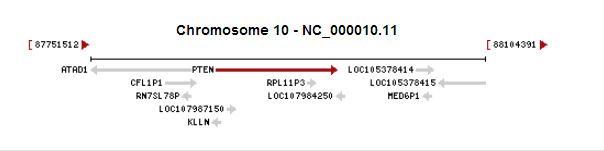
Gene introduction
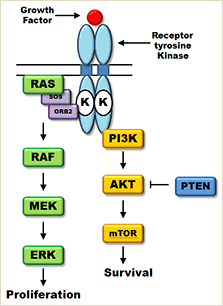
This gene was identified as a tumor suppressor that is mutated in a large number of cancers at high frequency. The protein encoded by this gene is a phosphatidylinositol-3,4,5-trisphosphate 3-phosphatase. It contains a tensin like domain as well as a catalytic domain similar to that of the dual specificity protein tyrosine phosphatases. Unlike most of the protein tyrosine phosphatases, this protein preferentially dephosphorylates phosphoinositide substrates. It negatively regulates intracellular levels of phosphatidylinositol-3,4,5-trisphosphate in cells and functions as a tumor suppressor by negatively regulating AKT/PKB signaling pathway. The use of a non-canonical (CUG) upstream initiation site produces a longer isoform that initiates translation with a leucine, and is thought to be preferentially associated with the mitochondrial inner membrane. This longer isoform may help regulate energy metabolism in the mitochondria. A pseudogene of this gene is found on chromosome 9. Alternative splicing and the use of multiple translation start codons results in multiple transcript variants encoding different isoforms. [provided by RefSeq, Feb 2015].PTEN (phosphatase and tensin homolog deleted on chromosome ten) is a lipid/protein phosphatase that plays a role in multiple cell processes, including growth, proliferation, survival, and maintenance of genomic integrity. PTEN acts as a tumor suppressor by negatively regulating the PI3K/AKT signaling pathway (Figure 1) via dephosphorylation of phosphatidylinositol (3,4,5)-trisphosphate (PIP3) at the cell membrane.Germline mutations of PTEN lead to inherited hamartoma and Cowden syndrome . PTEN activity can also be lost through other mechanisms such as epigenetic changes or post-translational modifications . Immunochemistry is often used to detect changes in expression of PTEN in tumor tissues; low expression is thought to indicate loss of PTEN expression, which would result in increased activity of the PI3K-AKT pathway.
Cancer pathway
The main pathways: Schematic of the MAPK and PI3K pathways. Growth factor binding to receptor tyrosine kinase results in activation of the MAPK signaling pathway (RAS-RAF-MEK-ERK) and the PI3K pathway (PI3K-AKT-mTOR). The letter "K" within the schema denotes the tyrosine kinase domain.
Related to cancer
Cancer-associated alterations in PTEN often result in PTEN inactivation and thus increased activity of the PI3K-AKT pathway. Somatic mutations of PTEN occur in multiple malignancies, including gliomas, melanoma, prostate, endometrial, breast, ovarian, renal, and lung cancers.
Alteration in cancer
| Gene | cDNA change | Protein change | Location |
|---|---|---|---|
| No data available. | |||
Related drugs in cancer
| Drug name | Other name | Product name | Type | Groups |
|---|---|---|---|---|
| No data available. | ||||