KRAS
Official symbol
KRAS
Official full name
KRAS proto-oncogene, GTPase
Gene ID
3845
Gene type
-
Other name
NS, NS3, CFC2, RALD, K-Ras, KRAS1, KRAS2, RASK2, KI-RAS, C-K-RAS, K-RAS2A, K-RAS2B, K-RAS4A, K-RAS4B, c-Ki-ras2
Gene location

Gene introduction
This gene, a Kirsten ras oncogene homolog from the mammalian ras gene family, encodes a protein that is a member of the small GTPase superfamily. A single amino acid substitution is responsible for an activating mutation. The transforming protein that results is implicated in various malignancies, including lung adenocarcinoma, mucinous adenoma, ductal carcinoma of the pancreas and colorectal carcinoma. Alternative splicing leads to variants encoding two isoforms that differ in the C-terminal region.
Cancer pathway
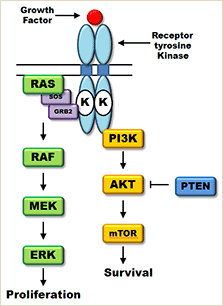
The main pathways: Schematic of the MAPK and PI3K pathways. Growth factor binding to receptor tyrosine kinase results in activation of the MAPK signaling pathway (RAS-RAF-MEK-ERK) and the PI3K pathway (PI3K-AKT-mTOR). The letter "K" within the schema denotes the tyrosine kinase domain.
Related to cancer
RAS has been implicated in the pathogenesis of several cancers. Activating mutations within the RAS gene result in constitutive activation of the RAS GTPase, even in the absence of growth factor signaling. The result is a sustained proliferation signal within the cell.This proto-oncogene is a Kirsten ras oncogene homolog from the mammalian ras gene family. A single amino acid substitution, and in particular a single nucleotide substitution, is responsible for an activating mutation. The transforming protein that results is implicated in various malignancies, including lung adenocarcinoma, mucinous adenoma, ductal carcinoma of the pancreas and colorectal cancer. Somatic KRAS mutations are found at high rates in leukemias, colorectal cancer, pancreatic cancer and lung cancer.
Alteration in cancer
| Gene | cDNA change | Protein change | Location |
|---|---|---|---|
| KRAS | - | p.G12X | Chromosome 12 |
| KRAS | - | p.G13X | Chromosome 12 |
| KRAS | - | p.X61X | Chromosome 17 |
| KRAS | - | p.X117X | Chromosome 17 |
| KRAS | - | p.X146X | Chromosome 17 |
Related drugs in cancer
| Drug name | Other name | Product name | Type | Groups |
|---|---|---|---|---|
| Afatinib | - | Gilotrif | Small Molecule | Approved |
| Cetuximab | DB00002 | Erbitux | Small Molecule | Approved |
| Erlotinib | - | Tarceva | Small Molecule | Approved |
| Gefitinib | ZD1839 | Iressa | Small Molecule | Approved |
| Osimertinib | - | Tagrisso | Small Molecule | Approved |
| Panitumumab | - | Vectibix | Small Molecule | Approved |