FGFR1
Official symbol
FGFR1
Official full name
fibroblast growth factor receptor 1
Gene ID
2260
Gene type
-
Other name
BFGFR,CD331,CEK,ECCL,FGFBR,FGFR-1,FLG,FLT-2,FLT2,HBGFR,HH2,HRTFDS,KAL2,N-SAM,OGD,bFGF-R-1
Gene location
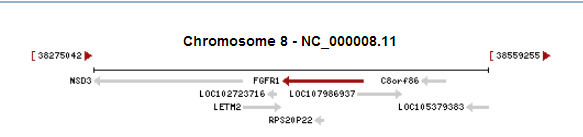
Gene introduction
The protein encoded by this gene is a member of the fibroblast growth factor receptor (FGFR) family, where amino acid sequence is highly conserved between members and throughout evolution. FGFR family members differ from one another in their ligand affinities and tissue distribution. A full-length representative protein consists of an extracellular region, composed of three immunoglobulin-like domains, a single hydrophobic membrane-spanning segment and a cytoplasmic tyrosine kinase domain. The extracellular portion of the protein interacts with fibroblast growth factors, setting in motion a cascade of downstream signals, ultimately influencing mitogenesis and differentiation. This particular family member binds both acidic and basic fibroblast growth factors and is involved in limb induction. Mutations in this gene have been associated with Pfeiffer syndrome, Jackson-Weiss syndrome, Antley-Bixler syndrome, osteoglophonic dysplasia, and autosomal dominant Kallmann syndrome 2. Chromosomal aberrations involving this gene are associated with stem cell myeloproliferative disorder and stem cell leukemia lymphoma syndrome. Alternatively spliced variants which encode different protein isoforms have been described; however, not all variants have been fully characterized. [provided by RefSeq, Jul 2008]. Sequence Note: This RefSeq record was created from transcript and genomic sequence data to make the sequence consistent with the reference genome assembly. The genomic coordinates used for the transcript record were based on transcript alignments. Publication Note: This RefSeq record includes a subset of the publications that are available for this gene. Please see the Gene record to access additional publications.
Cancer pathway
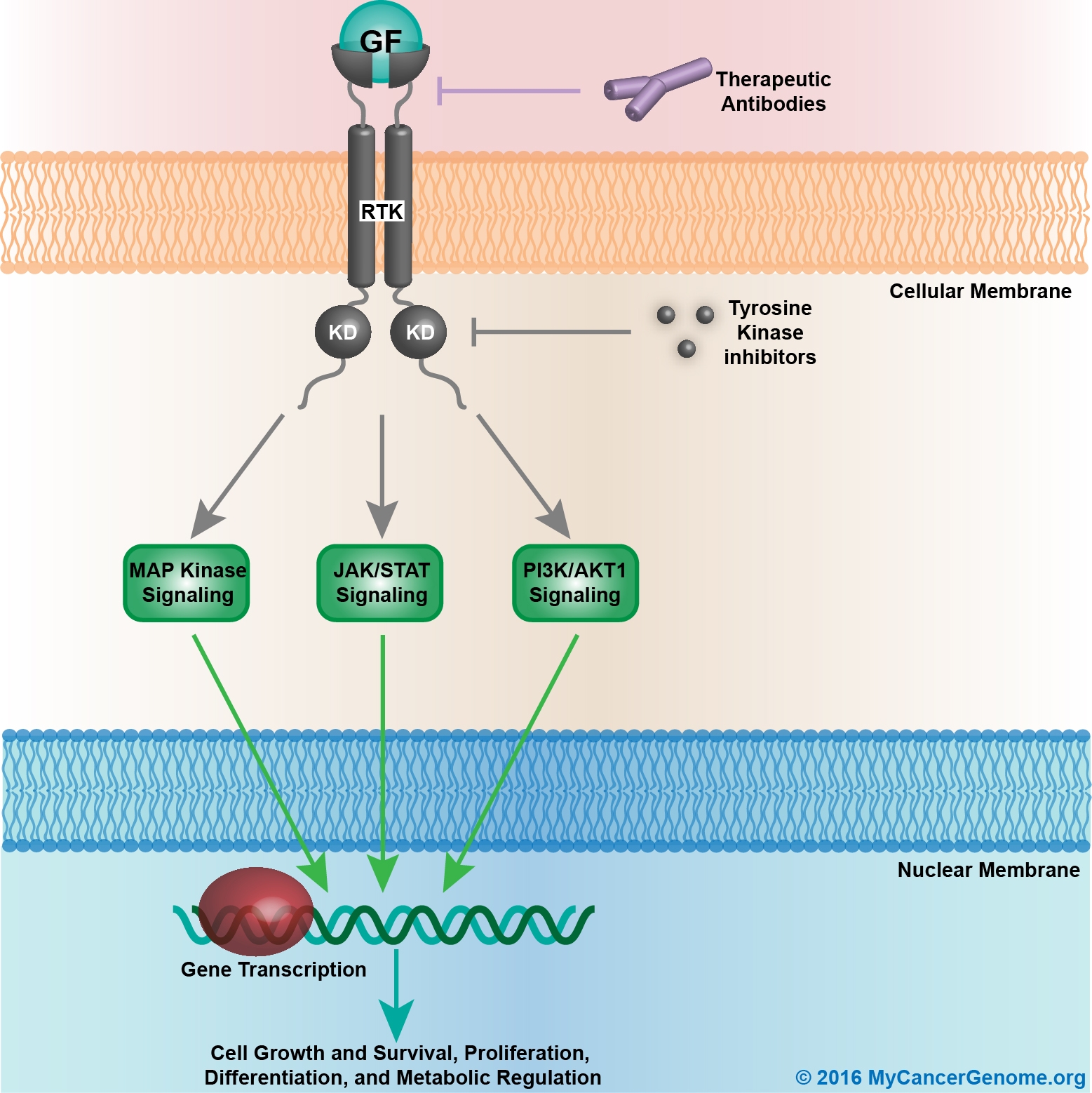
The main pathways: Binding of a growth factor (e.g., EGF, HGF) to a receptor tyrosine kinase activates the receptor tyrosine kinase and typically causes the dimerization of the two receptor monomers. The receptors are activated by phosphorylation within their kinase domains. Once the receptor is turned on, numerous downstream pathways are activated including MAP kinase signaling, JAK/STAT signaling, and PI3K/AKT1/MTOR signaling. Specific nodes in the pathway that are therapeutically actionable are noted. Click here to open a larger version of this image in a new window.
Related to cancer
-
Alteration in cancer
| Gene | cDNA change | Protein change | Location |
|---|---|---|---|
| No data available. | |||
Related drugs in cancer
| Drug name | Other name | Product name | Type | Groups |
|---|---|---|---|---|
| Ponatinib | - | Iclusig | Small Molecule | Approved |
| Regorafenib | - | Stivarga | Small Molecule | Approved |