CTNNB1
Official symbol
CTNNB1
Official full name
catenin beta 1
Gene ID
1499
Gene type
-
Other name
CTNNB,EVR7,MRD19,armadillo
Gene location
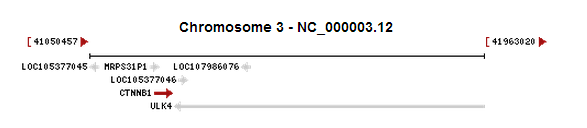
Gene introduction
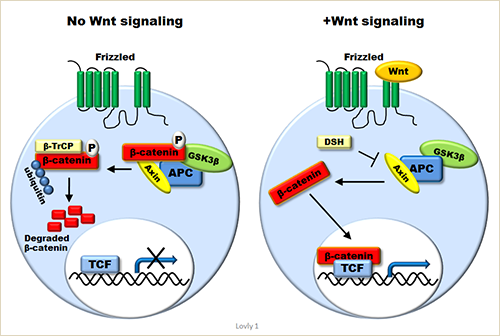
The protein encoded by this gene is part of a complex of proteins that constitute adherens junctions (AJs). AJs are necessary for the creation and maintenance of epithelial cell layers by regulating cell growth and adhesion between cells. The encoded protein also anchors the actin cytoskeleton and may be responsible for transmitting the contact inhibition signal that causes cells to stop dividing once the epithelial sheet is complete. Finally, this protein binds to the product of the APC gene, which is mutated in adenomatous polyposis of the colon. Mutations in this gene are a cause of colorectal cancer (CRC), pilomatrixoma (PTR), medulloblastoma (MDB), and ovarian cancer. Alternative splicing results in multiple transcript variants. [provided by RefSeq, Aug 2016].CTNNB1 is the gene which encodes the ß-catenin protein. ß-catenin is part of a complex of proteins that form adherens junctions, which are important for the establishment and maintenance of epithelial cell layers by regulating cell growth and adhesion between adjacent cells (Hartsock and Nelson 2008). ß-catenin is also part of the canonical Wnt signaling pathway . In the absence of Wnt signaling, glycogen synthase kinase-3 (GSK-3) phosphorylates ß-catenin, thereby targeting ß-catenin for degradation via the ubiquitin-proteasome system. When Wnt binds to its receptor, Frizzled, ß-catenin phosphorylation and ubiquitin-mediated degradation are blocked. ß-catenin is then free to translocate to the cell nucleus where it acts as a co-factor for the T-cell factor/lymphoid enhancing factor (TCF/LEF) transcription factors. The ß-catenin-TCF/LEF complex results in the activation of targets including c-MYC and Cyclin-D1.
Cancer pathway
The main pathways: Simplified schematic of the Wnt signaling pathway. In the absence of Wnt signaling, ß-catenin is phosphorylated by GSK-3, thereby resulting in poly-ubiquitination and degradation by the 20S proteasome system. When Wnt binds to its receptor, Frizzled, ß-catenin is stabilized. ß-catenin subsequently translocates to the nucleus, where it acts as a co-factor for the TCF/LEF family of transcription factors.
Related to cancer
Mutant CTNNB1 (ß-catenin) has been implicated in the pathogenesis of several cancers including melanoma, colorectal cancer, hepatocelluar carcinoma, and ovarian cancer.
Alteration in cancer
| Gene | cDNA change | Protein change | Location |
|---|---|---|---|
| No data available. | |||
Related drugs in cancer
| Drug name | Other name | Product name | Type | Groups |
|---|---|---|---|---|
| No data available. | ||||